
Whether attempting to resolve a bank overcharge, rectify a home insurance claim, chase a long-awaited healthcare appointment, recover a hacked Facebook account, deal with the DVLA, or simply request a refund for a wrong item, the processes have become an exhausting gauntlet. In the past, a direct phone call might have resolved a mistake or cleared up a problem; today, the reality is a cycle of navigating multiple departments and explaining the situation repeatedly to different representatives. Customers are promised call back that never materialise, or forced to endure complex phone queue systems where they must choose from irrelevant options, only to spend hours on hold before being told they must be transferred to yet another department, being put back in the same queue.
Service and support levels from most companies, government departments, or other organisations have always been frustrating for all people, but recent degradation of contact options has created a particularly debilitating, and disproportionately high barrier for people with ADHD. Organisations across the private and public sectors, driven by desire to reduce operational costs, have moved toward models that are increasingly automated and chronically under-staffed.
In many cases this includes the total removal of human interaction. Many organisations now rely on “raising a ticket” or forcing customers to engage with AI-driven responses that fail to grasp the specific context of the enquiry. Emails are often met with automated replies that do not answer the question, or scripted text provided by representatives who choose the closest available context without actually considering what has been said. Each interaction then taking a few days each to receive a response. These processes frequently drag on for weeks of back-and-forth, only for the company to eventually demonstrate that they never understood the original complaint. Customers are often dismissed with instructions to “read something on the website,” even when that information is entirely useless to their specific situation.
This a false economy for the organisations, they are left with unhappy customers who will need to keep contacting and using up more resource in disparate attempts (for something that could have been solved in a few minutes), and then leave negative reviews about their experiences. All those KPIs of closed tickets aren’t much good if they were really ‘fobbed off’ customers. But also, it can cause far more problems for some of their customers or service users than these organisations realise.
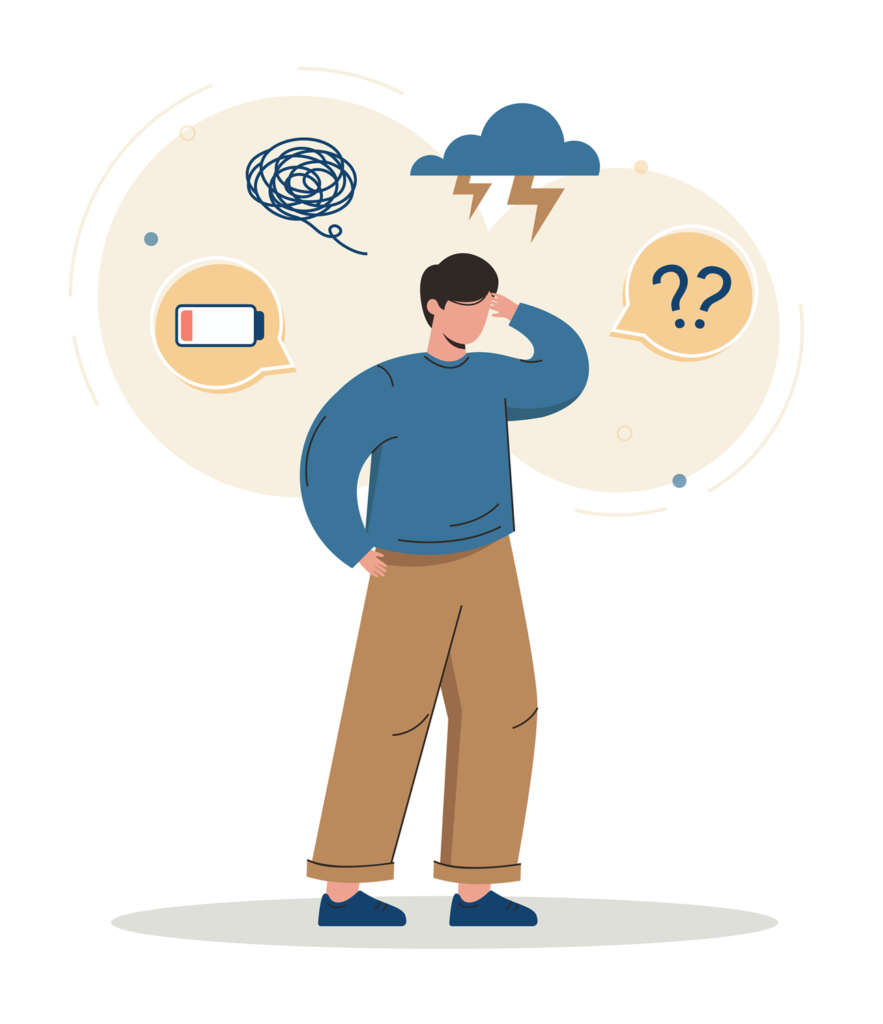
For those with ADHD, these service level failures are not just a minor annoyance, they are often a source of all-consuming stress and anxiety. The nature of the condition means that when a problem arises, the individual is often unable to “switch off” from thinking about it until it is resolved, or at least being resolved. While a neurotypical person might be able to put a day-to-day problem aside and return to it later, a person with ADHD will continuously roll the issue around in their head, looking for solutions even when the resolution is entirely dependent on an external body. This results in the individual being fully consumed by the problem, losing sleep, and finding themselves unable to go about their lives in the same way that others can while they wait for a resolution. This experience is due to specific neurological and motivational characteristics that make modern customer service processes extra distressing. Here are some study findings to explain why and how…
Excessive, Obsessive Rumination and Emotional Dysregulation over “Small” Problems
When a customer service representative doesn’t follow up with a response or provides one that doesn’t give an answer, they may view it as a small issue. But for the customer with ADHD, the intensity of the issue is far greater due to them having to ruminate:
- In ADHD, the Default Mode Network (DMN) which handles internal thought and reflection often fails to deactivate when the person needs to focus on external tasks. This results in ‘thought loops’ where a single negative experience or unresolved task becomes the dominant mental focus, making it impossible to disengage or ‘let it go’ (Brown, 2021).
- Rumination in ADHD involves an uncontrollable, evaluative focus on the causes and consequences of distressing events. Unlike healthy reflection, this process is unproductive and ‘sticky,’ often triggered by social interactions or perceived mistakes, and leads to significant mental fatigue (Joubert et al., 2022).
- Adults with ADHD experience ‘mental restlessness’ or ‘ceaseless mental overactivity.’ When a task (like a customer service complaint) remains unresolved, it occupies a disproportionate amount of cognitive ‘real estate,’ indirectly worsening symptoms of anxiety and depression through constant rumination (Kandeğer et al., 2023).
- Emotional dysregulation, including low frustration tolerance and high mood lability, is a core feature of adult ADHD. This means that minor stressors, such as a missed response from a company or a confusing online process, can trigger an intense, immediate emotional response that is difficult for the individual to self-regulate (Beheshti et al., 2020).
Delay Aversion and the “Pain” of Waiting
The lack of communication, delays, and long “back and forth” processes are particularly distressing for people with ADHD – because they have this “solution-focused” nature, and when they are dependent on others to fix a mistake, they are trapped for longer in the cycle of rumination. This inability to disengage from a customer service disputes is a matter of brain function:
- Delay aversion is a key motivational characteristic in ADHD… individuals with ADHD find the experience of waiting to be particularly aversive and will often engage in avoidant behaviours to escape the psychological discomfort of delay (Sonuga-Barke et al., 2018).
- In adults with ADHD, the deficit in delay gratification and increased delay aversion are linked to heightened impulsivity and frustration. When faced with administrative delays or waiting periods, the perceived ‘cost’ of the time spent is significantly higher than for neurotypical individuals, leading to more intense stress responses (Scheres et al., 2023).
- The ADHD brain experiences emotional signals more intensely. A delay that a neurotypical person might consider a ‘minor annoyance’ can be experienced by someone with ADHD as a significant personal failure or a high-stakes crisis, leading to rumination that persists for days or weeks (Bunford et al., 2021).
Impact on Daily Life
The rumination, emotional dysregulation, and delay aversion all culminate in stressors that have real-world, often intense impacts on daily life:
- The effort required for an ADHD individual to ‘chase’ a resolution, navigating phone menus, remembering details of previous calls, and managing the frustration of being misunderstood, creates a massive cognitive load… the person becomes too exhausted to manage work or family responsibilities” (Dodson, 2023).
- The “ceaseless mental overactivity” characteristic of ADHD ensures that even when an individual is physically present with family or friends, they are mentally “away,” ruminating on the unresolved dispute. This inability to disconnect from the stressor causes a secondary impact on social and domestic stability, as the individual remains irritable and distracted until the “loop” is closed (Bunford et al., 2021).
- In ADHD, the failure of the brain to deactivate the Default Mode Network means that an unresolved external problem acts like a background program consuming all available mental processing power. This results in “task paralysis,” where the individual is physically unable to initiate other daily chores or professional tasks because the brain is “locked” on the unresolved conflict (Brown, 2021).
And that’s before you consider the impact on sleep loss, which itself exacerbates ADHD challenges and creates more difficulties:
- Many adults with ADHD suffer from insomnia driven by ‘racing thoughts’ at bedtime. These thoughts are frequently centered on the day’s unresolved tasks or stressors. Because they cannot ‘switch off’ the internal dialogue regarding a problem, the physiological arousal prevents the transition to sleep (Pacheco, 2025).
- Research into sleep patterns reveals that rumination is a primary mediator between ADHD symptoms and poor sleep quality. The inability to stop thinking about a problem leads to delayed sleep onset and more frequent nighttime awakenings, which in turn worsens ADHD symptoms the following day (Faraone, 2024).
Neuroinclusion therefore requires companies and organisations to recognise that their current service levels, defined by delays, a lack of human contact, and complicated, dragging processes, inflict a disproportionate mental and physical tax on people with ADHD. When a problem is dragged out for weeks or months, it is not just a matter of “waiting”; it is a period of constant distraction, rumination, and sleep loss for the customer. To be neuroinclusive, organisations must prioritise clarity, reduce the need for constant “chasing,” and ensure that direct, human-led resolution is available.
With all of the above in mind, there is a cruel the irony in the multi-year long wait times for people to get an ADHD diagnosis, switch medication after side effect issues, or for an ADHD child to get their support.
References
Beheshti, A., Cassel, D. B., & Gratis, C. (2020). The role of emotional dysregulation in adult ADHD: A systematic review and meta-analysis. Journal of Attention Disorders, 24(12), 1643–1655. https://doi.org/10.1177/2043808720912583
Brown, J. (2021). Why can’t I let it go? Rumination and the ADHD brain. Focus: The Online Adult ADHD Magazine. https://focusmag.uk/why-cant-i-let-it-go-rumination-and-the-adhd-brain/
Bunford, N., Evans, S. W., & Wymbs, F. (2021). Emotional dysregulation in adult ADHD: What the research says about its impact on daily life. Psychological Medicine, 51(8), 1234–1245. https://pmc.ncbi.nlm.nih.gov/articles/PMC8533349/
Dodson, W. (2023). Why ADHD sleep is so disrupted — and how to fix it. ADDitude Magazine. https://www.additudemag.com/adhd-sleep-disturbances-symptoms/
Faraone, S. V. (2024).What sleep patterns reveal about mental health: A look at new research. World Federation of ADHD. https://www.adhdevidence.org/blog/what-sleep-patterns-reveal-about-mental-health-a-look-at-new-research
Joubert et al. (2022) Joubert, J. H., Kuckertz, J. M., & Riedel, R. (2022). Rumination and its relation to executive function and ADHD symptoms in adults. Journal of Psychopathology and Behavioral Assessment, 44(3), 742–753. https://doi.org/10.1007/s10862-022-09971-8
Kandeğer et al. (2023) Kandeğer, A., Selvi, Y., & Aydın, A. (2023). The relationship between mental restlessness, rumination, and clinical symptoms in adults with ADHD: A structural equation modeling approach. Nordic Journal of Psychiatry, 77(5), 456–463. https://doi.org/10.1080/08039488.2022.2144501
Pacheco, D. (2025, January 23). ADHD and sleep. Sleep Foundation. https://www.sleepfoundation.org/adhd-and-sleep
Scheres et al. (2023) Scheres, A., Tontsch, C., & Thoeny, A. L. (2023). Delay aversion and impulsivity in ADHD: A review of the phenotype and the neurobiological correlates. Neuroscience & Biobehavioral Reviews, 152, 105298. https://doi.org/10.1016/j.neubiorev.2023.105298
Sonuga-Barke et al. (2018) Sonuga-Barke, E. J. S., Cortese, S., Fairchild, G., & Stringaris, A. (2018). Annual Research Review: Transdiagnostic neuroscience of child and adolescent mental disorders – differentiating pathways to over-generalised and targeted interventions. Journal of Child Psychology and Psychiatry, 60(4), 346–381. https://doi.org/10.1111/jcpp.13005